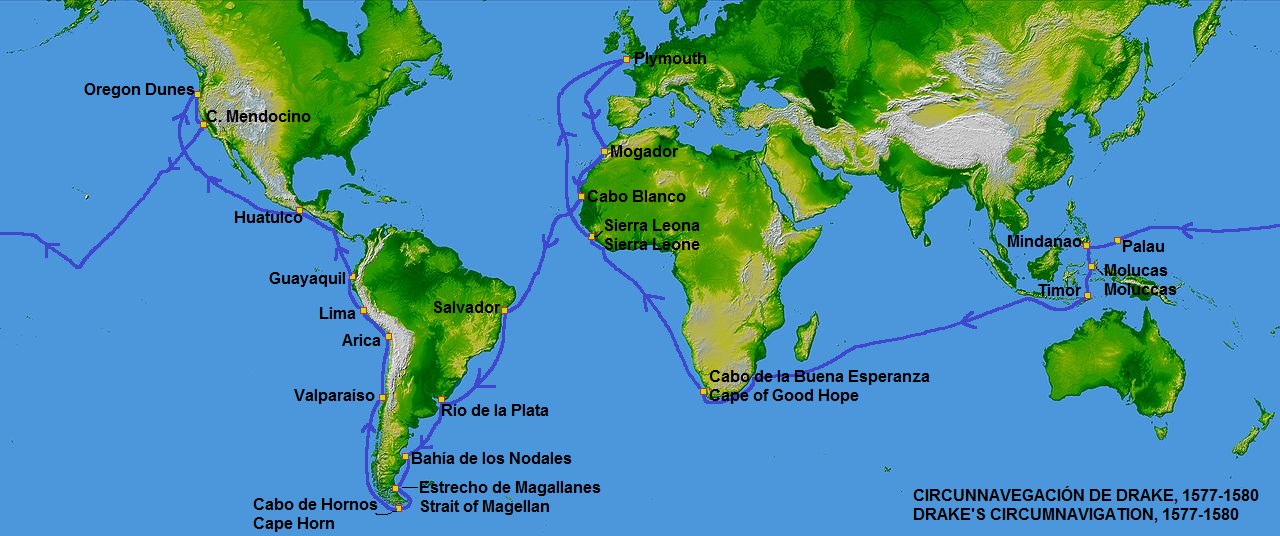
 A map showing Sir Francis Drake's circumnavigation of the globe from 1577 to 1580. (Image via Wikimedia)
Enlarge image
A map showing Sir Francis Drake's circumnavigation of the globe from 1577 to 1580. (Image via Wikimedia)
Enlarge image
1543
Bartolome Ferrelo sails north as far as the southwest coast of Oregon
1565
Manila Galleon trade route opens across North Pacific
1579
Sir Francis Drake allegedly visits Whale Cove
1603
Martin d-Aguilar sails along the Pacific Coast, sighting and naming Cape Blanco, reaching Coos Bay, and possibly sighting the Columbia River
1700
According to Indigenous oral history and scientific evidence, a large earthquake in the Cascadia Zone triggers a tsunami, destroying Native villages on the coast
1707
San Francisco Xavier probably wrecks at Nehalem
1738
Pierre Gaultier de la Verendrye leads first expedition into Oregon
1765
First use of word "Ouragon" in Maj. Robert Rogers' petition to explore American West
1774
Capt. Juan Perez sails to Northwest Coast for Spain
1775
Capt. Bruno Hezeta sees mouth of Columbia and names it Rio San Roque
1775-1780
First smallpox outbreak among Oregon’s indigenous people
1778
Capt. James Cook makes landfall at Cape Foulweather and discovers fur wealth of Northwest Coast
1788
Capt. Robert Gray trades with tribes in Tillamook Bay
Marius Lopius, African traveling with Gray, probably killed at Tillamook
1792
Capt. Robert Gray enters and names the Columbia River; Capt. George Vancouver expedition charts Columbia estuary; Lt. William E. Broughton names Mount Hood after British naval officer Alexander Arthur Hood
1801-1802
Second smallpox outbreak among Oregon’s Tribes
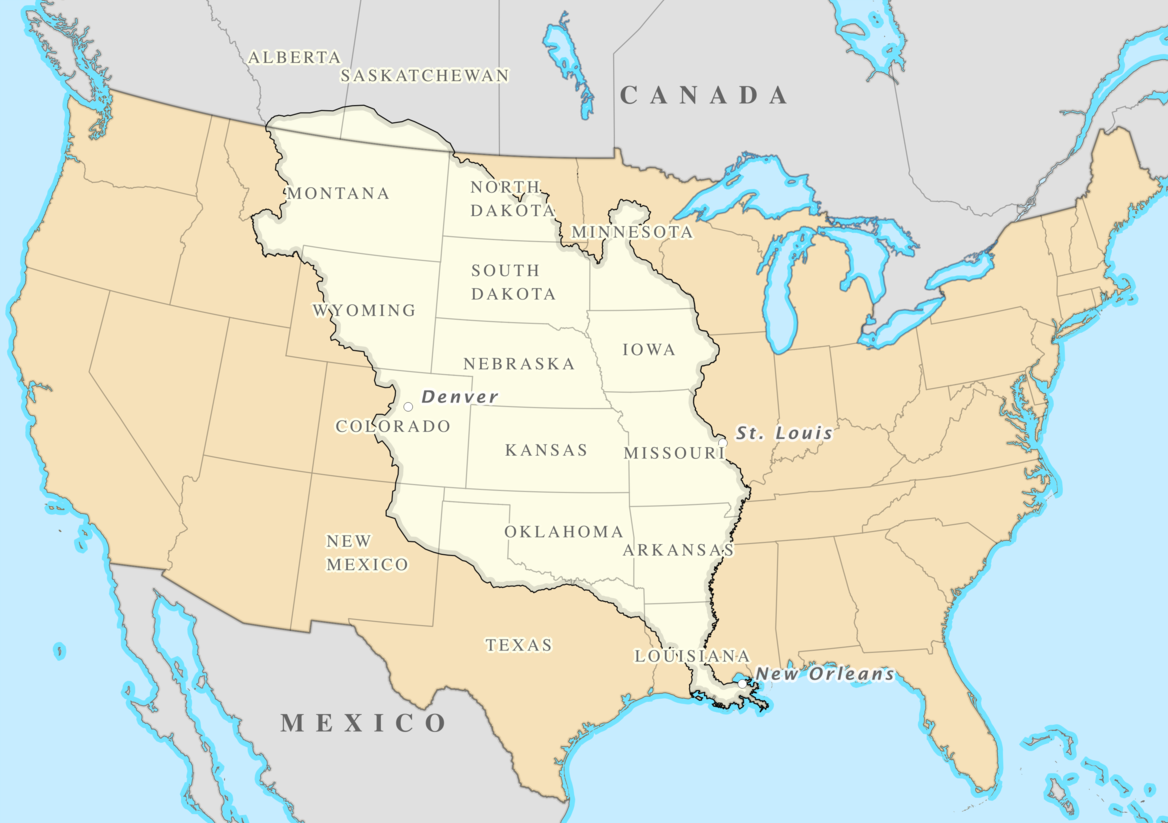 A map showing the territory associated with the Louisiana Purchase. (Image via Wikimedia)
Enlarge map
A map showing the territory associated with the Louisiana Purchase. (Image via Wikimedia)
Enlarge map
1803
Louisiana Purchase extends United States to Rocky Mountains
1804
President Thomas Jefferson dispatches Lewis & Clark Expedition
1805
Lewis & Clark Expedition explores lower Snake and Columbia Rivers and establishes Fort Clatsop
1806
Lewis & Clark Expedition returns to the United States
1811
John Jacob Astor’s Pacific Fur Company establishes Fort Astoria
1812
Overland Astorians discover South Pass in Wyoming, later route of Oregon Trail
1813
North West Company, a British enterprise, purchases Fort Astoria and names it Fort George
1814
First white woman to arrive in Oregon County, Jane Barnes, arrives at Fort George on North West Company’s ship; First domestic livestock imported by sea from California
1817
William Cullen Bryant refers to "Oregon" in poem Thanatopsis
1818
North West Company establishes Fort Nez Perce; James Biddle and John Prevost assert U.S. interests in Oregon; U.S. and Great Britain agree to "joint occupancy" of Oregon
1819
Adams-Onis Treaty cedes Spain's discovery rights north of 42 degrees to the U. S.
1821
Hudson's Bay Company subsumes North West Company
1824
U.S. and Russia agree to 50 degrees latitude as southern boundary of Russian interests; Dr. John McLoughlin begins long tenure as Chief Factor for Hudson’s Bay Company
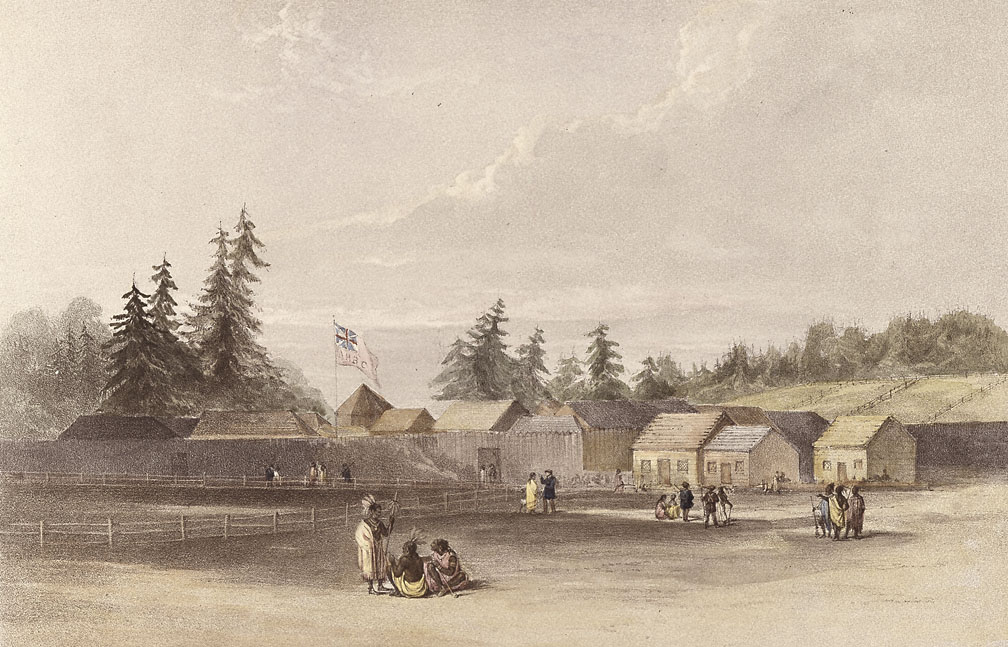 Fort Vancouver played a key role in the early development of the Oregon Country. See large version of this hand-colored lithograph Courtesy of the Oregon History Project.
1825
Workmen build Fort Vancouver on Columbia River
1827
First sawmill begins cutting lumber near Fort Vancouver
1828
Jedediah Smith’s party travels overland from California; First grist mill starts making flour at Fort Vancouver
1829
Dr. John McLoughlin establishes claim at Willamette Falls near a preexisting Indigenous village which later becomes Oregon City
1830
Fever pandemic begins calamitous death toll of tribes
1832
Newspapers report four Indians from Pacific Northwest in St. Louis seeking missionaries; Capt. B. L. E. Bonneville arrives overland to trap and trade for furs on Columbia Plateau; Hudson’s Bay Company establishes Fort Umpqua at Elkton
1833
First school opens at Fort Vancouver; First lumber exports by Hudson’s Bay Company to China
1834
Minister Jason Lee establishes Methodist Mission near Wheatland with the goal of converting Indigenous people to Christianity
1836
First steamship Beaver begins service for Hudson’s Bay Company on the Columbia River; Lt. William Slacum mounts reconnaissance of western Oregon; Whitman-Spalding mission party arrives overland via Oregon Trail; Washington Irving publishes Astoria
1838
Willamette Cattle Company drives livestock overland from California; Priests Blanchet and Demers arrive overland from Canada and celebrate first Catholic mass in the Pacific Northwest
1839
Catholics establish mission at St. Paul; First printing press in the Northwest brought to Lapwai (now Idaho) from Honolulu and used to print a Nez Perce primer, the first book produced in the Pacific Northwest
1841
Ewing Young’s death leads to public meetings; First Catholic boys’ school founded at Saint Paul; First ship, Star of Oregon, built by settlers
1842
Methodist missionaries found the Oregon Institute in Salem, a predecessor to Willamette University; First brick building (a house) erected by George Gay in Polk County
1843
First large migration of over 900 immigrants arrives via Oregon Trail; Lt. John C. Fremont mounts reconnaissance of Oregon Trail; “Wolf Meetings” lead to Provisional Government; Oregonians submit petition to Senate seeking U.S. jurisdiction
1844
First town plat surveyed at Oregon City; First Catholic girls’ school founded at Saint Paul; Acts to prohibit slavery and exclude Black and mulatto people from the Oregon Territory were passed and the "Lash Law" enacted requiring Black residents, "be they free or slave - be whipped twice a year until he or she shall quit the territory"
1845
Meek Cutoff opens as alleged short cut to Oregon Trail; Estimated 3,000 overland immigrants arrive; Oregonians petition Congress for federal services; First Provisional governor, George Abernethy, elected; Francis Pettygrove and A. L. Lovejoy name Portland and commence plat of city
1846
Barlow Road opens as toll route; Applegate Trail, alternative to Oregon Trail, opens; Oregon Treaty affirms U.S. sovereignty to Pacific Northwest; First newspaper on the west coast, Oregon Spectator, founded in Oregon City
1847
First Indian war, the Cayuse War begins at Waiilatpu (also known as the Witman Massacre); First postmaster, John Shively, named at Astoria; First English book, a Blue Back Speller, printed in Oregon City
1848
Joseph Meek carries petition east seeking federal "patronage"; Organic Act creates Oregon Territory; James Marshall discovers gold in California; First U.S. Customs Service office opens in Astoria
1849
First territorial governor, Joseph Lane, assumes duties; First Mounted Riflemen of U.S. Army arrive overland; First “Beaver” gold coins minted in Oregon City
1850
Congress passes Oregon Donation Land Act; First capital punishment—five Cayuse men are hanged in Oregon City; Investors start printing The Oregonian in Portland
1851 to 1900