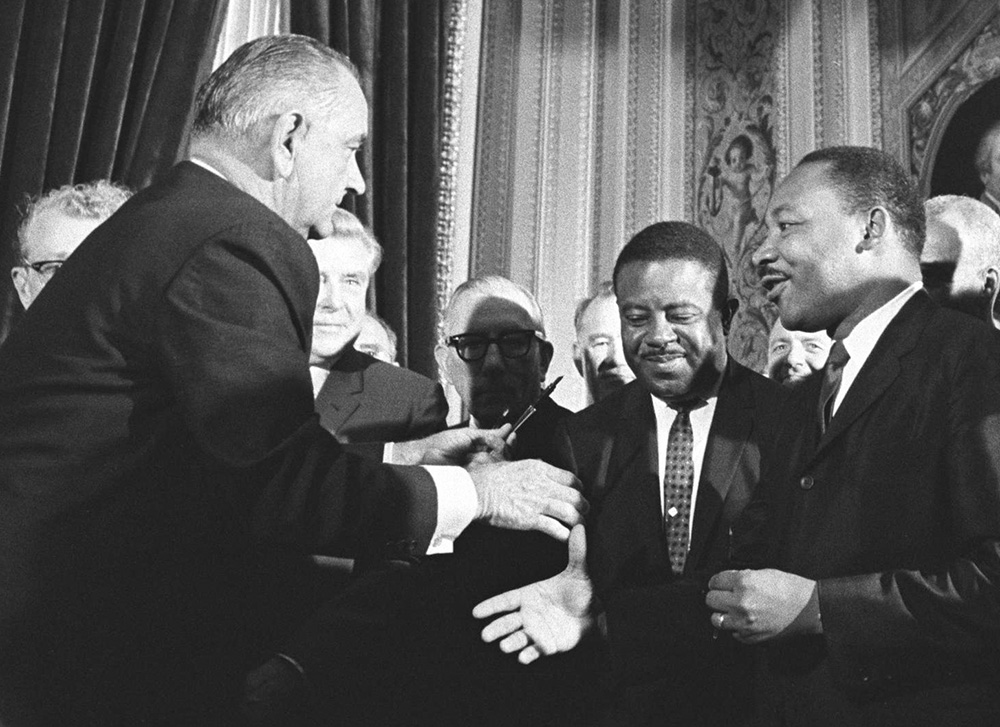
 President Lyndon B. Johnson [left] and civil rights leader Martin Luther King [right] at the signing of the Voting Rights Act in 1965. (By Yoichi Okamoto; Courtesy of Lyndon Baines Johnson Library and Museum)
The situation changed after World War I, when native men who received honorable discharges from the Army also gained U.S. citizenship. Ratification of the 19th Amendment in 1920 eased the concerns of native women that they would retain rights to property and suffrage. Finally, in 1924, the Indian Citizenship Act granted citizenship to "all non-citizen Indians born within the territorial limits of the United States.” Prior to its passage, though, nearly two-thirds of Native Americans in the U.S. were already citizens by marriage, military service, or forced assimilation.
Issues of Indigenous Access
Though all Native Americans in the U.S. are citizens now, with some even holding dual citizenship, there is still an ongoing struggle to secure voting rights for indigenous people. Disenfranchisement began in 1924, with states implementing poll taxes, literacy tests, and voter intimidation. The 1965 Voting Rights Act dealt with some of these issues, particularly for older Native Americans who were more fluent in their traditional languages than English.
As the courts have slowly dismantled the Voting Rights Act, many indigenous people in 2020 have less voter access than they did just a few decades ago. Native communities often suffer from stringent voter ID laws which restrict access to the ballot box. There also remains a scarcity of polling stations in – or even close to – the western reservations which nearly a million Native Americans call home.
Indigenous Voting Rights in Oregon