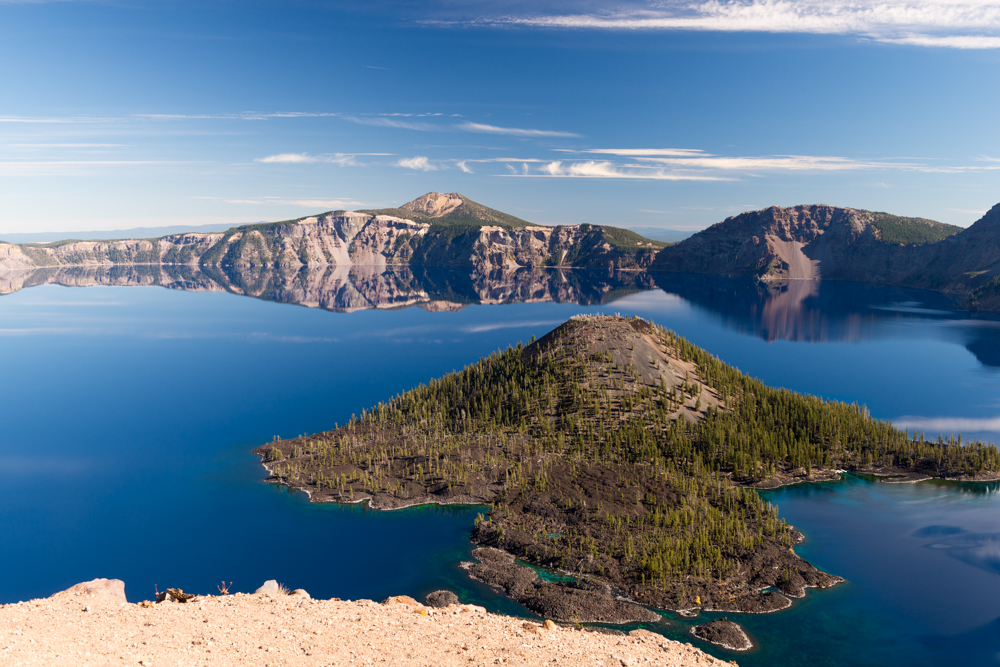
 Crater Lake National Park opened in 1902. (Oregon Scenic Images collection)
1902
Crater Lake National Park opens; Congress passes Federal Reclamation Act; Voters amend Constitution for Initiative and Referendum, allowing citizens to propose new laws and constitutional amendments
1903
Heppner Flood kills 225 people; First Voters' Pamphlet published
1904
Direct primary law passes; First Black American man, George Hardin, named officer in Portland Police Bureau
1905
Lewis and Clark Centennial Exposition commemorates the 100th anniversary of the Lewis and Clark Expedition; Klamath Irrigation Project begins; Oregon land fraud trials pursue high-profile wrongdoers
1906
City home rule law approved, allowing extensive city lawmaking authority; Indictment by grand jury law approved; Taxes begin on telephone, telegraph and railroads; First meeting of Association of Oregon Counties
1907
President Theodore Roosevelt creates "Midnight Reserves" setting aside millions of acres of national forests
1908
Constitution amended for Recall provision; First woman, Lola Baldwin, named head of Women’s Division, Portland Police
1909
State’s Central Fish Hatchery opens at Bonneville; Oregon Caves National Monument created; Pendleton Round-Up begins; Congress passes Enlarged Homestead Act; Carolyn B. Shelton serves as acting governor when Governor Chamberlain resigns to be sworn in as U.S. Senator. She serves for 48 hours, and is Oregon’s first female governor
1910
Three-fourths verdict in civil cases approved; Employers’ Liability Act approved
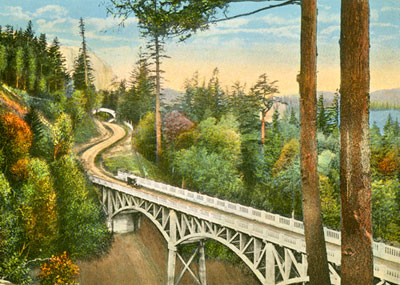 Construction began on the Columbia River Gorge Highway in 1911. (Oregon State Archives Image)
1911
Columbia River Gorge Highway construction begins; First U.S. primary elections held in Oregon; Oregon Trunk Railroad completes line to Bend
1912
Women’s suffrage approved; Prohibition of private convict labor approved; Eight-hour day on public works approved; First U.S. minimum wage law approved
1913
Presidential preference primary law approved; Governor Oswald West declares beaches open to public
1914
Death penalty abolished; Prohibition approved; Eight-hour day approved for women; Congress revests O & C Railroad land grant; Marian B. Towne is first woman elected to Oregon’s House of Representatives; Legislature requires publication of Oregon Blue Book
1915
Kathryn Clarke wins Douglas County special election to serve as first woman in the Oregon Senate
1916
Workmen complete Celilo Locks and Canal; Congress passes Stock-Raising Homestead Act
1917
U.S. Army Spruce Production Division begins logging
 An Army war enlistment poster from World War I.
1918
Influenza pandemic kills hundreds; Emergency Fleet Corporation contracts for ships; Oregonians enlist to serve in World War I
1919
First state gasoline tax in U.S. authorized to fund highways
1920
Death penalty reinstated; Oregon League of Women Voters founded
1921
Ku Klux Klan organize chapters; Hurricane hits Oregon and Washington; ballot measure allowing women to serve as jurors passes
1922
First state park opened by Oregon Highway Commission south of Monmouth, named for Sarah Helmick; Compulsory School Act approved, outlawing private and parochial schools and requiring children aged 8 to 18 to attend public school; First Black American woman, Beatrice Cannady, graduates from Lewis & Clark Law School; Japanese American Citizens’ League founded
1923
Alien Land Law approved, preventing first generation Japanese Americans from owning or leasing land; Alien Business Restriction Law approved, denying business licenses to first generation Japanese Americans; Prohibition of sectarian garb in schools approved
1924
Congress extends citizenship to Native Americans; Compulsory School Act held unconstitutional; Mary Jane Spurlin first female judge in Oregon; Clarke-McNary Act aids federal-state forest fire protection
1925
State parks and waysides authorized; League of Oregon Cities founded
1926
Fishwheels abolished; Astor Column completed; Exclusion of Black Americans clause removed from Constitution
1927
State Constitution amended to remove voting restrictions on Black and Chinese people
1929
State Park Commission created
 An irrigation ditch near Vale. (Oregon Scenic Images collection)
1930
Vale Irrigation Project begins water delivery; First Oregon woman judge, Mary Jane Spurlin, appointed to Multnomah County District Court
1933
Tillamook Burn destroys 350,000 acres of old growth timber; Civilian Conservation Corps and Works Projects Administration start projects
1934
First grazing district under Taylor Grazing Act forms at Bonanza
1935
Congress authorizes Bonneville Dam; Fire destroys State Capitol
1936
11 die as Bandon Fire destroys town; Nan Wood Honeyman is first Oregon woman elected to U.S. House of Representatives; Five major bridges are completed on Highway 101
1937
President Franklin D. Roosevelt dedicates Timberline Lodge and Bonneville Dam; Gas chamber built at Oregon State Penitentiary for capital punishment; Oregon Shakespeare Festival forms in Ashland; Congress creates Bonneville Power Administration; Bankhead-Jones Act authorizes buyout of homesteaders
1938
544 Report approved for Willamette River flood control; Bonneville Dam completed
1939
Second Tillamook Burn destroys 310,000 forest acres; State capitol completed in Salem
1941
Oregonians enlist to serve in World War II
1942
Executive Order 9066 authorizes removal of Japanese Americans to internment camps; Japanese submarine shells Fort Stevens; Siskiyou National Forest firebombed by Japan; U.S. Army builds Camp Adair and Camp Abbot; U.S. Navy builds Tillamook and Tongue Point Naval Air Stations; Vanport founded to house wartime workers
1945
Six Oregonians die in explosion of Japanese incendiary balloon near Bly; Third Tillamook Burn destroys 125,000 forest acres; Supplement to 1923 Alien Land Law passes
1946
Portland State University founded; Rural School Law encourages consolidation of districts
1947
Plane crash kills Governor Snell, Secretary of State Farrell, and others
1948
Columbia River Flood destroys Vanport; Vollum and Murdock found Tektronix
1949
State Department of Forestry begins replanting Tillamook Burn; Fair Labor Practices Commission established; State Supreme Court invalidates 1923 and 1945 Alien Land acts; First woman, Dorothy McCullough Lee, elected Portland mayor
1951 to Present