Abbreviation, Oregon
OR (postal)
Alternative Energy
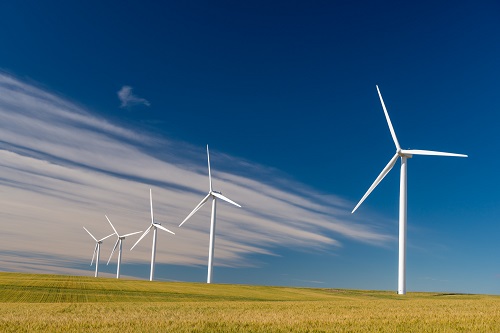 Wind turbines on Monkland Lane in Sherman County. (Oregon Scenic Images collection)
Geothermal (2022)
- 38.7 Megawatts Total Capacity
- 47 Megawatts Planned Capacity
- 181,543 Megawatt Hours Generated (2022)
Solar (2022)
- 1,282 Megawatts Total Capacity
- More than 24,000 residential solar projects
- 2,128,519 Megawatt Hours Generated (2022)
Wind (2022)
- 3,957 Megawatts Total Capacity
- 51 operating facilities
- 8,269,603 Megawatt Hours Generated (2022)
Hydropower (2022)
- 9,068 Megawatts Total Capacity
- 105 hydropower facilities
- Smallest (operating): 0.025 megawatt
- Largest: 2,160 megawatts (John Day Dam, Columbia River)
- 31,375,170 Megawatt Hours Generated (2022)
- Oregon is the second highest hydropower-producing state in the nation, behind only Washington.
Altitudes
- Highest: Mt. Hood (11,239')
- Lowest: Pacific Ocean (sea level)
Amusement Park, Oldest
Oaks Amusement Park, Portland. Opened in May, 1905, is one of the oldest continuously operating amusement parks in the United States.
Animal, State
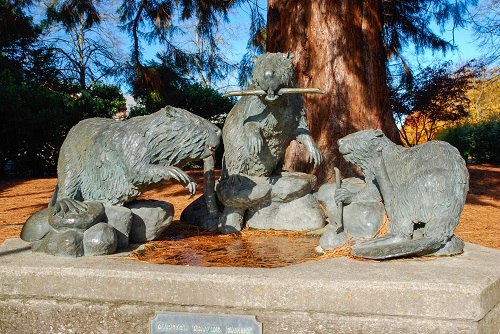 A beaver family statue next to the Oregon State Capitol in Salem. Marion County. (Oregon Scenic Images collection)
The 1969 Legislature named the American Beaver (Castor canadensis) the Oregon state animal. Prized for its fur, the beaver was overtrapped by early settlers and eliminated from much of its original range. Through management and protection, the beaver has been reestablished in waterways throughout the state. The beaver has been referred to as “nature's engineer,” and its dam-building activities are important to natural water flow and erosion control. Oregon is known as the “Beaver State.” The beaver is Oregon State University's mascot.
Apportionment, US House of Representatives
(number of U.S. Representatives from Oregon)
- 1860-1880: 1
- 1890-1900: 2
- 1910-1930: 3
- 1940-1970: 4
- 1980-2022: 5
- 2022-Present: 6
Awards (Nobel, Pulitzer)
 Linus Pauling won two Nobel prizes.
- 1934: William P. Murphy, Nobel, Medicine
- 1934:
Medford Mail Tribune, Pulitzer, Journalism
- 1939: Ronald Callvert,
The Oregonian, Pulitzer, Editorial Writing
- 1954: Linus Pauling, Nobel, Chemistry
- 1956: Walter H. Brattain, Nobel, Physics
- 1957: Wallace Turner and William Lambert,
The Oregonian, Pulitzer, Local Reporting
- 1962: Linus Pauling, Nobel, Peace
- 1990: Nicholas D. Kristof, with wife Sheryl WuDunn,
The New York Times, Pulitzer, International Reporting
- 1999: Richard Read,
The Oregonian, Pulitzer, Explanatory Writing
- 2001: Carl Weiman, Nobel, Atomic Physics
- 2001:
The Oregonian, Pulitzer, Public Service
- 2001: Tom Hallman, Jr.,
The Oregonian, Pulitzer, Feature Writing
- 2005: Nigel Jaquiss,
Willamette Week, Pulitzer, Investigative Reporting
- 2006: Rick Attig and Doug Bates,
The Oregonian, Pulitzer, Editorial Writing
- 2006: Nicholas D. Kristof,
The New York Times, Pulitzer, Commentary
- 2007:
The Oregonian, Pulitzer, Breaking News Reporting
- 2010: Dale T. Mortensen, Nobel, Economics
- 2014:
The Oregonian, Pulitzer, Editorial Writing
- 2021: Mitchell S. Jackson, Pulitzer, Feature Writing
Beverage, State
Milk was designated Oregon's state beverage in 1997. The Legislature recognized that milk production and the manufacture of dairy products are major contributors to the economic well-being of Oregon agriculture.
Birds, State
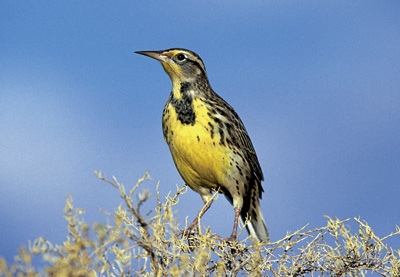 The Western Meadowlark is Oregon's state bird. (Noah Strycker)
Songbird
Distinctive for its flute-like song, the Western Meadowlark (Sturnella neglecta) was chosen to be the state bird by the Oregon Audubon Society-sponsored schoolchildren's 1927 election. The selection was proclaimed by Governor Patterson in July, 1927, and the 2017 Legislature declared the Western Meadowlark to be the State Songbird. Native to western North America, the bird has brown plumage with buff and black markings. Its underside is bright yellow with a black V-shape on the breast. Outer tail feathers are mainly white and are easily visible when it flies.
Raptor
The Osprey (Pandion haliaetus) was designated state raptor by the 2017 Legislature, declaring the large bird with its striking markings to be a fitting symbol of Oregon's rugged independence, strength and resilience, evoking Oregon's lakes, rivers, streams and ocean.
Births
38,168 (2023 preliminary)
Borders and Boundaries
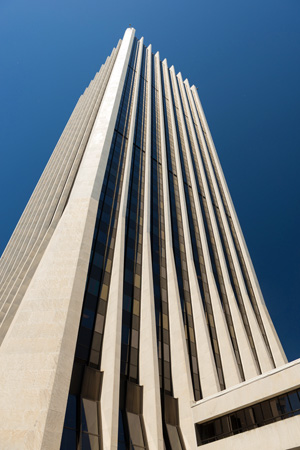 The Wells Fargo Tower in downtown Portland is the tallest building in the state. (Oregon State Archives Photo)
- Washington on the north
- California on the south
- Idaho on the east
- Pacific Ocean on the west
- Nevada on the southeast
Bridges
Highest: Thomas Creek Bridge, north of Brookings, 345'
Longest: Megler Bridge, Astoria, 21,474'
Covered bridges: 51; 33 of which are located in the Willamette Valley
Buildings, Tallest (Portland)
- Wells Fargo Tower (1972), 546', 40 floors
- Park Avenue West (2016), 537', 30 floors
- U.S. Bancorp Tower (1983), 536', 42 floors
Cities, Total Incorporated
241
Largest Populations (2024)
- Portland (639,448)
- Salem (177,567)
- Eugene (177,155)
Counties, Total
36
Largest Area, Sq. Mi.
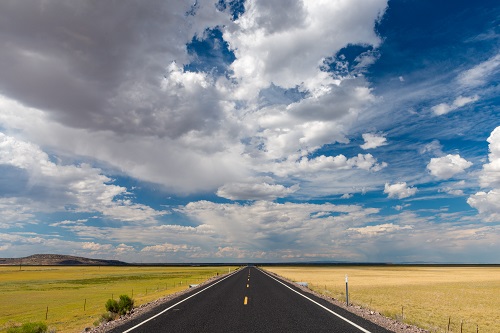 Harney County is the largest county in the state. (Oregon Scenic Images collection)
- Harney (10,133)
- Malheur (9,888)
- Lake (8,139)
Smallest Area, Sq. Mi.
- Multnomah (431)
- Hood River (522)
- Columbia (657)
Largest Populations (2024)
- Multnomah (800,227)
- Washington (611,389)
- Clackamas (426,567)
Craft Brewing Industry (2023)
318 craft breweries (ranks 12th nationally)
Barrels of craft beer produced per year: 895,741 (ranks 7th nationally)
Crustacean, State
The 2009 Legislature designated the Dungeness Crab (Metacarcinus magister) as the official state crustacean. The action followed petitioning by the fourth grade class of Sunset Primary School in West Linn. Common to the Pacific coastline from the Alaskan Aleutian Islands to Santa Cruz, California, Dungeness Crab is considered the most commercially important crab in the Pacific Northwest.
Next: Dance to Hops Production